Accessibility links Skip to main content

Saving water starts with insight: How Egbert Leiting helps organisations use water and energy more efficiently

For many organisations, water is taken for granted. It flows from taps, cools installations, heats buildings, and supports industrial processes. Only when costs rise, systems fail, or sustainability becomes a priority does a key question emerge: are we actually using water efficiently?

Continue reading
A gloved hand fills a sample jar with water from a faucet for laboratory testing or water analysis.

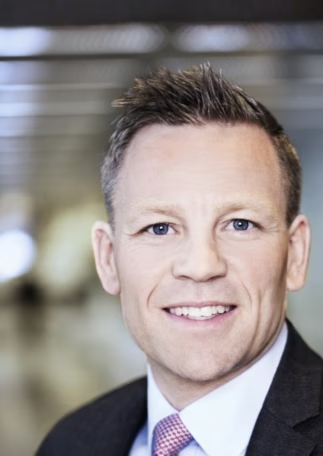
According to Egbert Leiting, this question represents a major opportunity. As Technical Director at Normec Kalsbeek and Normec Aquaserva, he works every day on safe water, water conservation, and energy efficiency. “Water plays a crucial role in almost everything we do,” Egbert explains. “It’s not only essential for health and safety, but also a key medium for energy transport in buildings and industrial processes.”

Driven by that belief, it comes as no surprise that Egbert joined the ESG Change Champion community. According to Egbert, water management is one of the most underestimated elements of ESG policy. While organisations often focus on electricity or CO₂ emissions, water usage and quality have just as much impact on sustainability, operational reliability, and costs. “When you use water more intelligently, you almost automatically reduce energy consumption as well,” he says. “Less water means less heating, less pumping, and less strain on installations.”

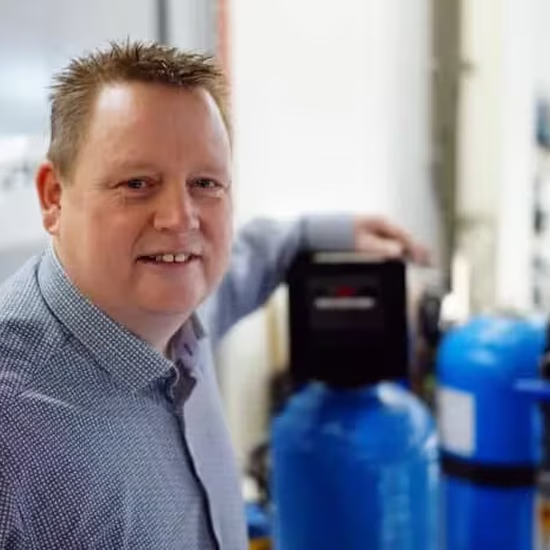
A person is standing next to water treatment or water analysis equipment in a laboratory or technical work environment.

From compliance to real impact

In many organisations, attention to water starts with regulations or safety concerns, such as drinking water systems, showers, or cooling towers. But according to Egbert, the real value lies in going beyond compliance and focusing on continuous improvement. “We regularly conduct water scans for companies,” he explains. “We not only look at safety and quality, but also identify where water is lost or used unnecessarily.”

These analyses often reveal surprising opportunities, such as:

  • Systems that continuously consume water without being noticed
  • Installations using more energy due to contamination or poor water quality
  • Outdated equipment with excessive water demand
  • Processes where water reuse is possible

“Many organisations underestimate how much they can save without major investments,” Egbert says. “In many cases, small technical adjustments already deliver immediate results.”


Looking ahead: smarter water use in buildings and industry

In the coming year, Egbert will focus particularly on the areas where he sees significant untapped potential: water conservation in buildings and industrial environments. Through water scans and practical advice, his goal is to help organisations identify opportunities for both water and energy savings, often through targeted improvements in systems and water quality.

His message is straightforward: “Start small, but start. Gaining insight into water usage almost always reveals opportunities for sustainability, cost savings, and better system performance.”

Specialists in Testing, Inspection & Certification

Discover Normec: an international network of specialists in testing, inspection, certification, laboratory analysis, consultancy and training.

Contact us

Fill out the form and we will contact you shortly.

Naam
Privacy Policy 

Related articles

Visual representation of sustainability, the circular economy, and the responsible use of natural resources.
29 Jul 2026

From ambition to action: How Marcel Jeschke brings ESG to life

For Marcel, ESG isn’t a separate project or a box to tick. It’s something that should show up in everyday decisions across the organisation. The real challenge? ESG often stays too abstract. Real impact starts when you translate ambition into actions people can actually use in their daily work.

Wind turbines in a vast agricultural area, visible above a field of flowering crops.
14 Jun 2026

Building a culture of responsibility: How Tatiana Pershukova drives ESG from within

Since joining Normec Hybeta in 2019 as Fleetmanager and Training and Seminar Manager, Tatiana has developed a clear view on what ESG principals should look like in practice. “For me, ESG is not about big buzzwords or perfect concepts. It’s about awareness and small, practical improvements that make a difference over time.” Taking on the role of ESG Change Champion therefore felt like a natural step: an opportunity to turn that belief into something tangible within the organisation.

02 Jun 2026

Mark Taylor appointed Chief Commercial Officer of Normec Group

Throughout his career, Mark has successfully built and professionalised commercial organisations, driving both organic and acquisition-led growth in private equity-backed environments. His appointment marks an important step in strengthening Normec’s commercial capabilities as the group continues to expand internationally.

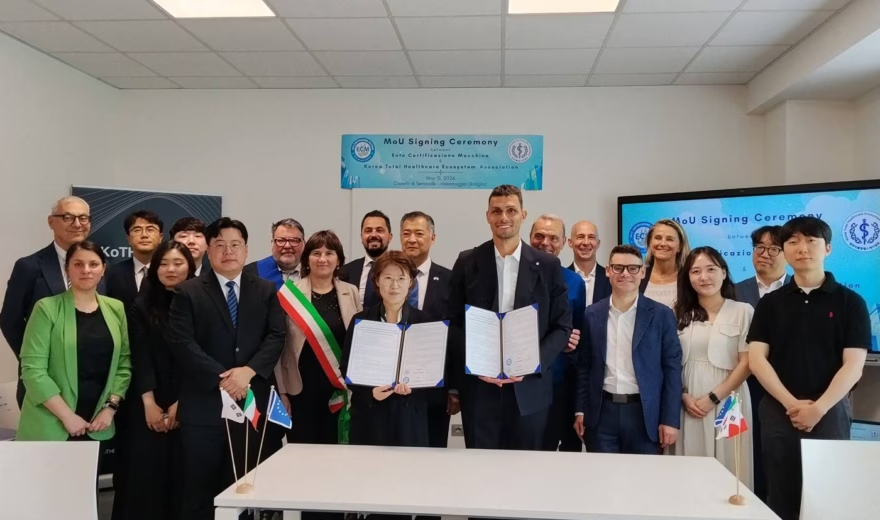
A group of participants poses with the signed documents during a formal gathering in a conference room.
27 May 2026

Strategic partnership between Normec and KOTHEA strengthens European access for Korean digital health companies

Bologna, Italy – May 2026 – Normec announces the signing of a Memorandum of Understanding (MoU) between its Italian medical device certification entity Ente Certificazione Macchine (ECM) and the Korea Total Healthcare Ecosystem Association (KOTHEA)

02 Feb 2026

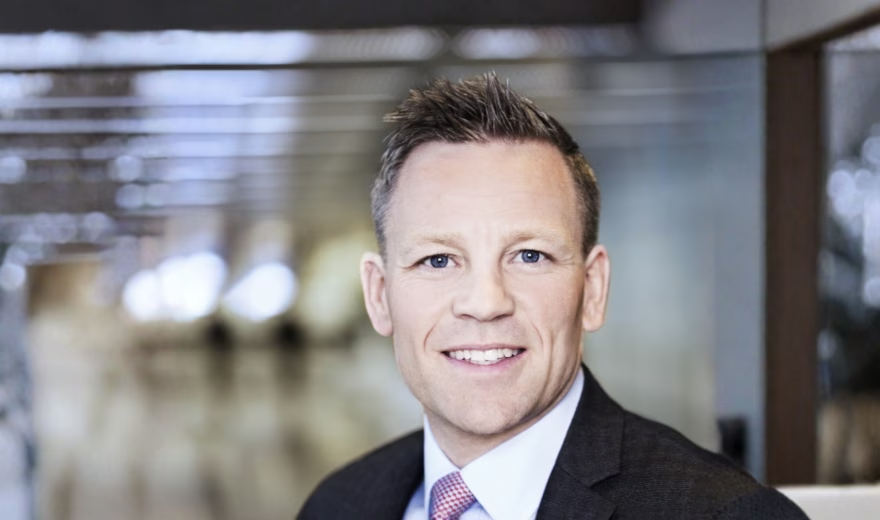
Mads Dehlsen Winther appointed Chief Financial Officer of Normec Group

Amsterdam, 2 February 2026 – Normec announces the appointment of Mads Dehlsen Winther as its new Chief Financial Officer (CFO), effective today.

A globe icon with circular arrows above a river in a densely forested area, symbolizing sustainability and the circular economy.
18 Dec 2025

Normec supports forest restoration in Zambia to drive a sustainable future

Deforestation is one of the most pressing environmental challenges of our time. Across the globe, forests are disappearing at an alarming rate, threatening biodiversity, water security and the fight against climate change. In Zambia’s Copperbelt Province, this reality is stark. Intensive mining and charcoal production have stripped away 239,000 hectares of trees between 2011 and 2021. The consequences are severe: degraded land, reduced carbon storage and vulnerable communities.

Aerial view of a winding river flowing through a vast forest and nature reserve.
16 Dec 2025

The EU Deforestation Regulation (EUDR): the road to deforestation-free raw materials

The European Union is taking a major step in the global fight against deforestation with the EU Deforestation Regulation (EUDR). For companies in the food industry, both in the Netherlands and Belgium, this means a significant shift in how raw materials are sourced, monitored, and documented. QA managers will play a key role in implementing and complying with this new regulation. But what exactly does the EUDR entail, where do we stand today, and how can your organisation best prepare?